Mark Lohan Kitchens: scaling bespoke manufacturing for the contract market
How an established Irish manufacturer is applying premium residential-grade quality to large-scale commercial projects

Mark Lohan, celebrating 25 years’ making award-winning kitchens
Mark Lohan Kitchens (MLK) is best known for its high-grade residential work, but a visit to its Roscommon headquarters quickly reveals a business that is already operating at industrial scale. During a recent visit, Irish Contract Interiors editor John Legg toured the company’s showroom and manufacturing facilities and spoke with the team about their expanding contract operation.
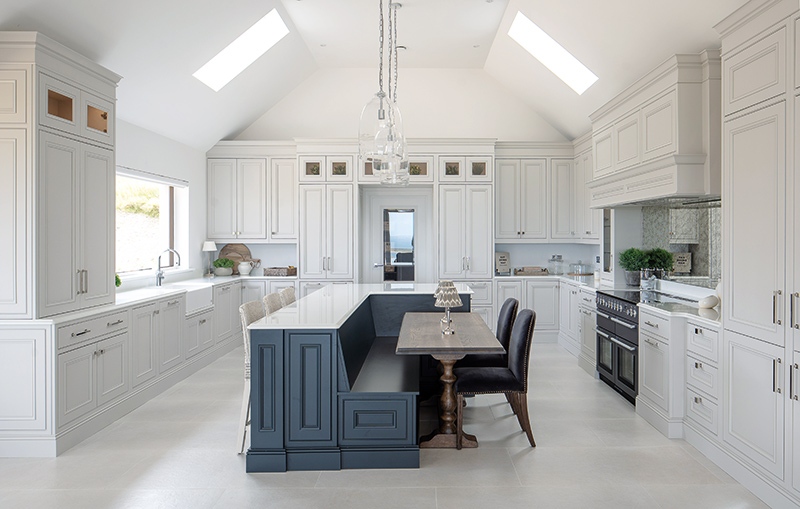
For Mark Lohan Kitchens, 2025 has been a watershed year culminating in a triple win at the Irish Kitchen Trade Awards

For Mark Lohan Kitchens, 2025 has been a watershed year culminating in a triple win at the Irish Kitchen Trade Awards
With two manufacturing facilities, integrated production and a growing contract division, MLK is deliberately aligning its residential-grade craftsmanship with the demands of large-scale delivery. But rather than reinventing itself, the company is extending a proven manufacturing model into the contract sector – applying the same disciplines of process, control and craftsmanship to provide a multi-unit delivery for a growing number of builder, developer and contractor customers.
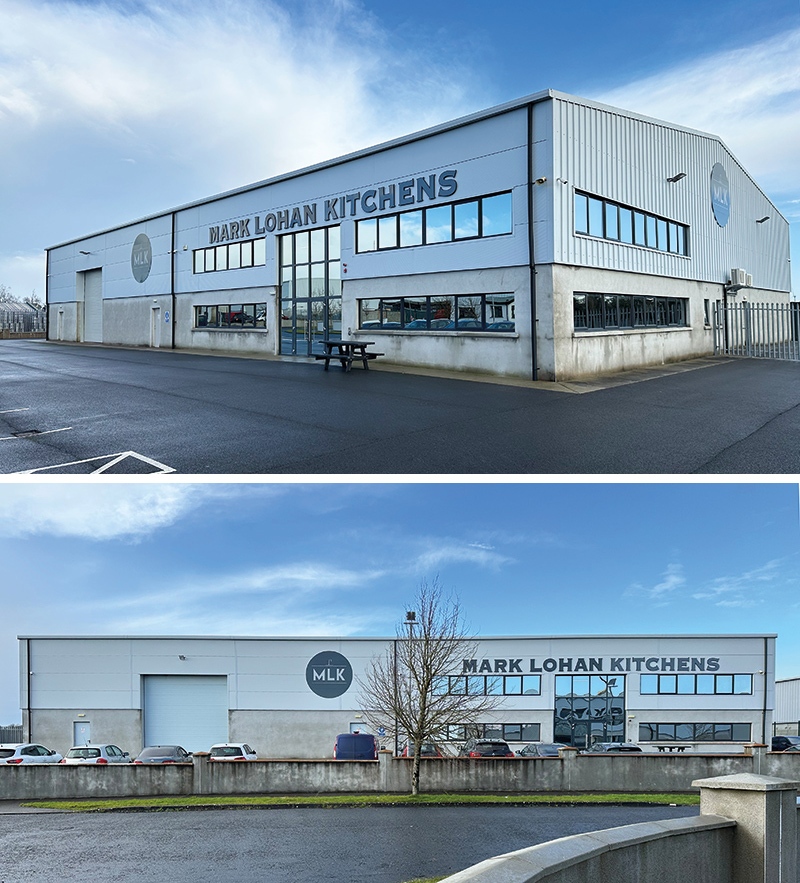
MLK's two production plants sit opposite one another
From established brand to scaled manufacturing partner
Commercial Contracts Manager Darryl Lipscombe joined MLK eight months ago with a clear brief: accelerate the company’s growth in the contract sector. With over a decade’s experience in commercial kitchens and fit-out manufacturing, he was recruited specifically to strengthen the company’s presence among developers and main contractors.
Commercial work already represents a significant share of turnover and is now growing strongly. Darryl expects approximately 30% year-on-year growth, with a medium-term objective of contract work accounting for 40-45% of the business.
This growth is underpinned by manufacturing headroom rather than overstretched capacity. MLK currently operates a single shift across its CNC-led production floor, giving it immediate scalability. “If we needed to, we could introduce a split shift and effectively double output without major capital investment,” Darryl explains.
For developers, this matters. The ability to absorb additional volume quickly is a core requirement when selecting manufacturing partners: “They need to know that if they award you a 100-plus unit project, you have the capacity and systems to deliver it. That confidence is fundamental.”
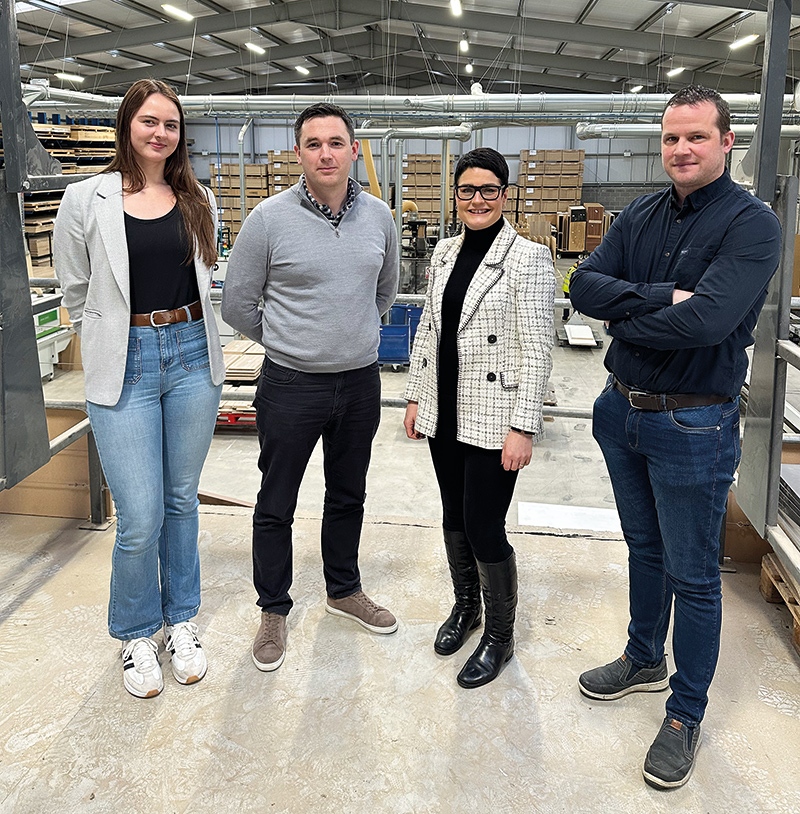
From left: Ricarda Bolle, Operations Lead; Gary McCaffrey, Installation and Logistics Operations Manager; Sinead Fannon, Marketing Manager; and Darryl Lipscombe, Commercial Contracts Manager
A deliberately focused contract strategy
MLK has avoided the common mistake of trying to be all things to all markets. Darryl is clear that the business has a tightly defined contract remit: “We are residential fit-out specialists. Housing developments and apartment schemes – kitchens and wardrobes and cabinets for the living areas – that is our focus.”
This focus allows MLK to industrialise what it already does best, rather than diluting expertise across incompatible sectors.
The company is already delivering large-scale housing and apartment projects across Cork, Galway and the east of the country, with multi-site programmes forming an increasing share of workload. Apartment schemes in particular provide steady production flow, an important stabilising factor as output scales.
Built for volume without compromising control
If Darryl defines MLK’s market positioning and line of approach, Gary McCaffrey explains why the business is operationally credible.
Gary, Installation and Logistics Operations Manager, joined MLK six months ago after senior roles in large PLC-owned construction firms. His background brings a programme-led, risk-aware mindset typical of tier-one contracting environments.
From his perspective, contract manufacturing is not more complex than residential, but more disciplined: “The difference is volume and certainty. Once the specification is agreed, contract work is highly structured. Our systems and factory layout are already designed for repeatable output.”
MLK’s production environment is configured for scale, with CNC-led machining, centralised assembly and integrated logistics. Spare capacity exists not by accident, but by design, allowing the business to respond to fluctuating contractor programmes without destabilising existing workloads. As Gary puts it: “It’s a strong position to be in. We can increase output quickly without re-engineering the factory.”
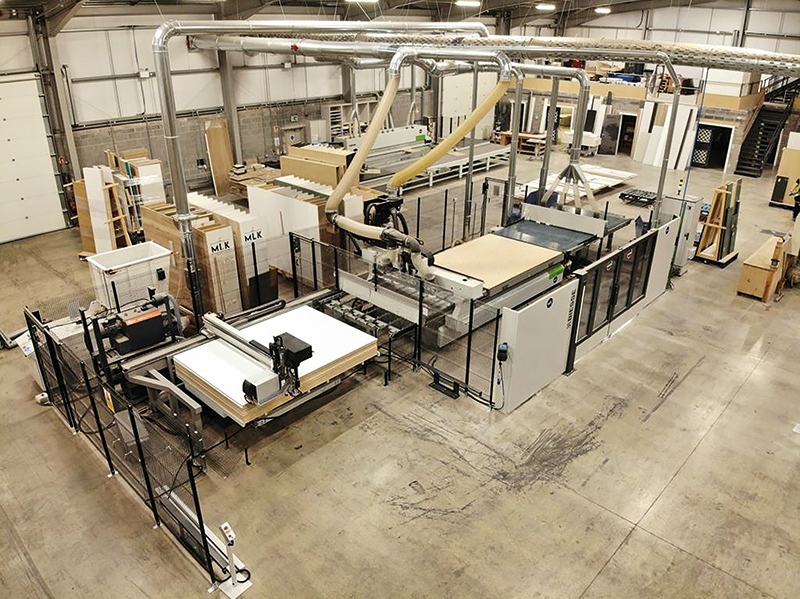
CNC-led manufacturing ensures performance and consistency
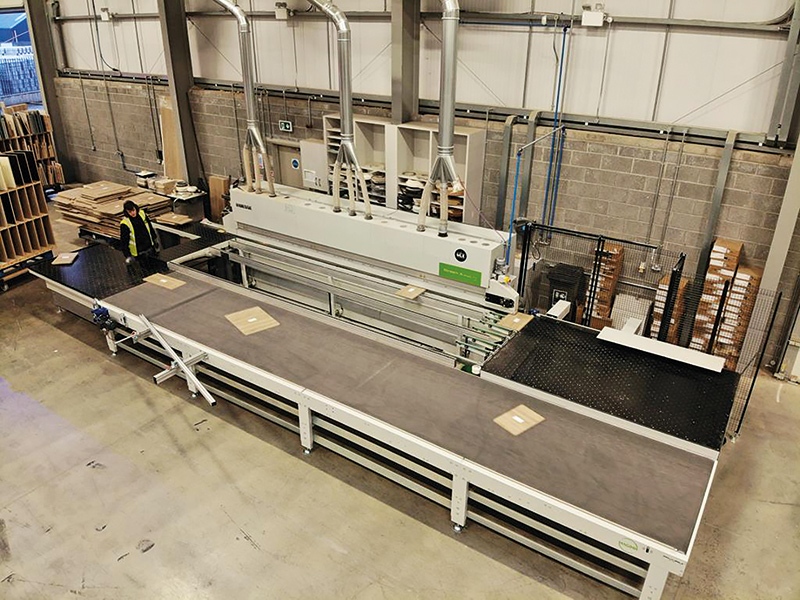
A manufacturing culture built for scale
That operational discipline is evident the moment you step onto MLK’s production floor. During the visit, Marketing Manager Sinead Fannon describes a business that has grown through deliberate long-term investment rather than incremental expansion.
Mark Lohan originally started the company from a garage at his family home but quickly recognised that serious scale would require serious infrastructure. Instead of remaining a small craft operation, he invested heavily in purpose-built facilities, first in 2019, and again with a major expansion in 2023. Today, MLK employs more than 70 people, reflecting a long-held ambition to build a national manufacturing brand rather than a lifestyle business.
That intent is reflected across the factory environment itself. The production floor is clean, ordered and highly structured, with automation introduced not only for efficiency but also for health and safety. Sheet materials are mechanically fed into machines, improving workflow reliability and reducing manual handling. Assembly benches are organised by project, with teams working through scheduled programmes generated via the company’s ERP system. Progress is visible across departments, ensuring production remains coordinated and predictable as volumes increase.
In dispatch, every pallet is checked piece by piece against the original order before leaving the factory to their separate assembly unit located opposite ensuring nothing is missing when it reaches site, a small detail that carries significant consequences on live projects.
Sinead notes that this operational backbone is what differentiates MLK within its sector. Rather than focusing solely on front-end presentation, MLK has prioritised building robust, industrial-grade manufacturing capability behind the scenes. This foundation supports consistent large-scale delivery and underpins the company’s growth ambitions in both Ireland and the UK.
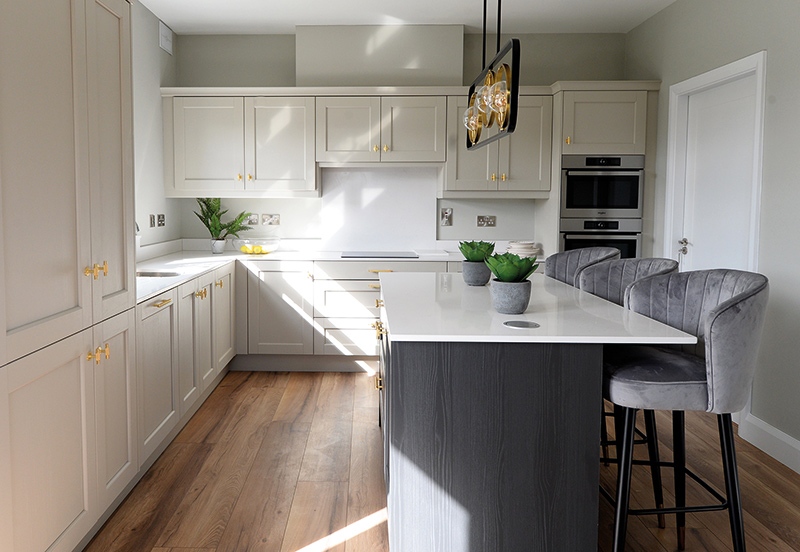
MLK’s completed work for a large development – Chancel Way, Newcastle, Co. Wicklow, developed by Dwellings
Precision at scale: eliminating site risk
One of the biggest risks for developers is inconsistency across multi-unit delivery. Gary argues this is where MLK’s residential manufacturing discipline becomes a competitive advantage: “All units are made in the same factory, by the same teams, to the same standards – whether it’s one kitchen or one hundred.”
Crucially, MLK does not treat contract projects as generic batches. Every unit is measured individually, even on large schemes. “Every room is surveyed. Every drawing is slightly different because buildings are never perfect. If you ignore those tolerances, the problems only appear when the kitchen is installed –
and that’s when scrutiny is highest.”
By engineering tolerance into manufacturing, MLK reduces snagging, rework and reputational risk, persistent pain points in high-volume residential delivery.
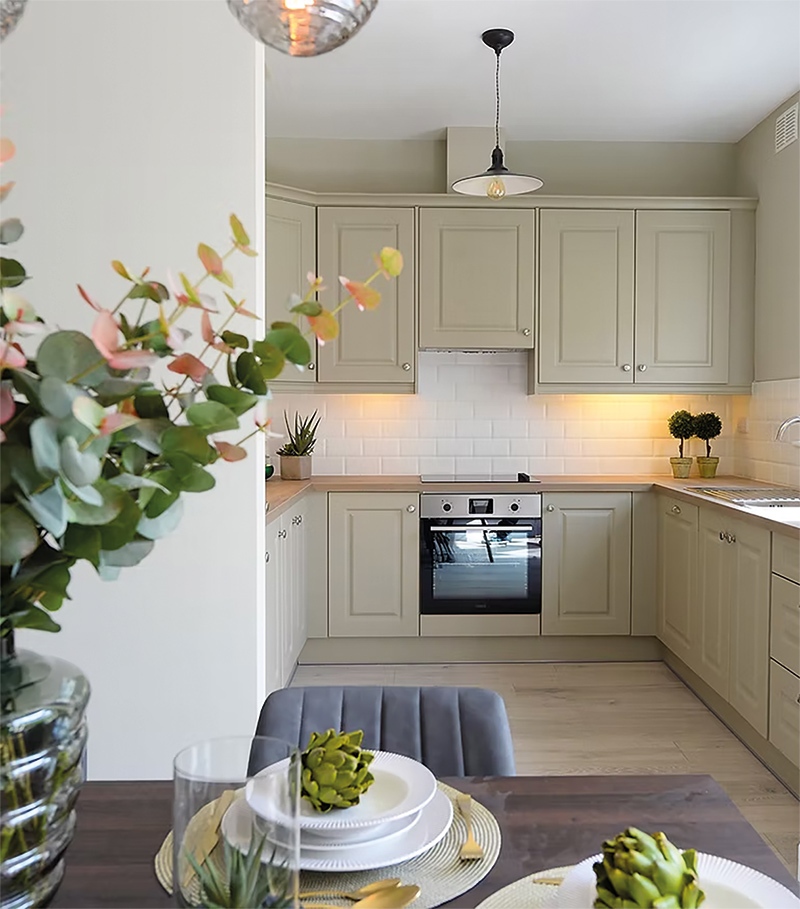
MLK’s work featured at Beaulieu Banks, Drogheda, developed by DwellingsStructured flexibility in live construction environments
Gary is candid about the realities of construction programmes: “There is no such thing as a standard delay. We’ve seen everything from weeks to years.”
Rather than allowing delays to cascade into production crises, MLK deliberately maintains operational buffer capacity. This allows the company to reschedule projects without destabilising its pipeline, a key differentiator in a sector where overstretched suppliers are all too common.
The same applies to lead times. While residential projects operate on 10-12 week cycles, contract projects typically require delivery within four weeks of final sign-off. MLK structures production and fitting resources accordingly, ensuring it can respond rapidly without sacrificing quality or delivery certainty.

MLK supplied the kitchens and other cabinetry to developer Ian Morrissey, for a six-house project, Bóthar Stiofain in Knocknacarra, Co. Galway
Digital systems underpinning scalable growth
Operational discipline is reinforced by digital infrastructure. Ricarda Bolle, Operations Lead at MLK, leads the implementation of Crow’s Nest, a system which has become central to project visibility and capacity planning, as well as a growing bank of internal management data.
The platform consolidates project data, purchasing, scheduling and reporting into a single operational backbone. “Capacity planning is fundamental. Knowing whether you can absorb a project before committing to it is essential as the business grows.”
For developers, this translates into better forecasting, clearer communication and reduced delivery risk.
A proven model applied at scale
MLK’s contract proposition is not theoretical. It is built on industrial-scale manufacturing with built-in headroom, combined with residential-grade quality control and individual unit measurement across multi-unit schemes. This is reinforced by operational flexibility to accommodate delayed programmes and integrated digital planning systems that support controlled growth.
For Darryl, the message is direct: “We deliver. Once partners work with us, they see that we understand the realities of contract delivery.”
MLK is not repositioning itself, it is skillfully scaling a proven manufacturing model into the contract arena. For residential developers seeking dependable long-term partners, that combination of craftsmanship and operational discipline is increasingly rare.