From good practice to market proof
Why sustainability reporting matters for Irish woodworking and interiors SMEs
Larger and medium-sized business are more inclined to publish sustainability reports
Yet the commercial reality is moving faster than the legal requirement. Even where an SME is not obliged to publish a formal sustainability report, its larger customers, public-sector clients, funders and supply-chain partners may increasingly ask for evidence about emissions, materials, waste, sourcing, working practices and governance.
Where Irish SMEs stand
That is the central message emerging from the 2025 Sustainable SMEs interview analysis, led by Ida Norberg of BioFuel Region with contributions from the project consortium. Sustainable SMEs is an EU Interreg Northern Periphery and Arctic initiative involving IWIN; the Sligo-based AIM Centre, which supports manufacturers and supply-chain businesses on their digitalisation journeys; and partners in Finland, Sweden and Iceland. Interviews with 29 companies, supported by a further 32 interviews with SME stakeholders, provide a useful snapshot of where businesses stand and what is holding them back.
The sample is modest – and Iceland was represented by only one company – but the comparisons are still instructive.
The research found that 55% of the companies interviewed were already undertaking some form of sustainability reporting. More than half rated their maturity at four or five on a five-point scale, although these stronger scores came mainly from large and, to a lesser extent, medium-sized businesses. Micro and small enterprises were much less likely to report and typically cited lack of time, people and clarity.
Irish SMEs were generally at an earlier stage than their Finnish and Swedish counterparts. Their approaches were less systematic, automation was limited and there was considerable uncertainty about what information to collect and which rules applied. That finding should not be read as evidence that Irish firms are necessarily less sustainable in practice. Many may already be reducing waste, controlling energy use, buying certified material, managing health and safety and maintaining traceability. The weakness is often that these activities are not consistently measured, documented or presented in a form a customer can readily use.
Lessons from Finland and Sweden
Finland and Sweden offer valuable benchmarks. Finnish SMEs were more likely to integrate sustainability into strategy and operations and to treat it as a competitive advantage. Swedish firms benefited from a stronger culture of voluntary reporting, more advanced digital tools and active industry networks. Even there, however, reporting was far from effortless: manual processes remained common, regulations were seen as complex and Scope 3 emissions – those arising across the wider value chain – were particularly difficult to measure.
These international findings closely match the practical challenges of the wood and furniture sector. The report identifies component-level carbon footprints, raw-material traceability, Scope 3 emissions and the tracking of production side-streams as recurring difficulties. For an IWIN member, that can mean assembling information from board and hardware suppliers, energy bills, transport records, waste contractors, production systems and purchasing files. If each customer asks for the information in a different format, the burden quickly multiplies.
“The answer is not to begin with a glossy report or expensive software. It is to build a reliable, proportionate information system”
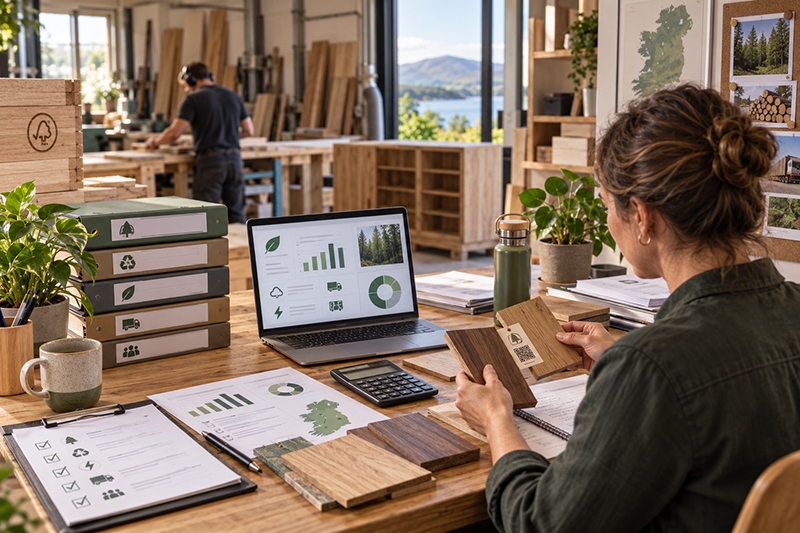
Smaller firms are much less likely to report its sustainability position citing lack of time, people and clarity
Start with the information that matters
The answer is not to begin with a glossy report or expensive software. It is to build a reliable, proportionate information system. The EU’s Voluntary Sustainability Reporting Standard for SMEs (VSME) is intended to give smaller firms a common framework with which to answer recurring requests from customers, banks and other stakeholders. In practice, a sensible starting point for an IWIN business is a short list of measures that matter commercially: energy and fuel use; waste by type and destination; recycled or certified material content; key supplier information; transport data; workplace safety; training; and basic governance controls.
Much of this information may already exist in invoices, spreadsheets, ERP systems and certificates. The first task is to assign responsibility, agree definitions and collect it at regular intervals. Excel may be entirely adequate at the outset. More sophisticated platforms and dashboards become worthwhile when the volume of data, number of sites or customer demands justify them. The research shows that even mature Finnish and Swedish companies combine specialist tools with Excel, ERP systems, consultants and manual work.
Making support more sector-specific
Irish businesses are not without support. Interviewees pointed to Local Enterprise Offices, SEAI, Enterprise Ireland programmes, Climate Toolkit 4 Business, Climate Ready, consultants and peer networks. The greater opportunity for IWIN is to make that support sector-specific: common definitions, shared templates and realistic benchmarks for manufacturers, joinery firms, fit-out contractors and furniture businesses could substantially reduce duplication.
Turning evidence into commercial value
Sustainability reporting should ultimately earn its keep. Stakeholders interviewed in Ireland associated it with efficiency gains, cost savings, competitiveness and access to funding. Across the wider study, proactive reporting was also linked with market access, stronger customer trust and, in some cases, winning contracts. The immediate objective, therefore, is not reporting for its own sake. It is to turn good practice into credible evidence – and credible evidence into lower costs, stronger tenders and more resilient customer relationships.